

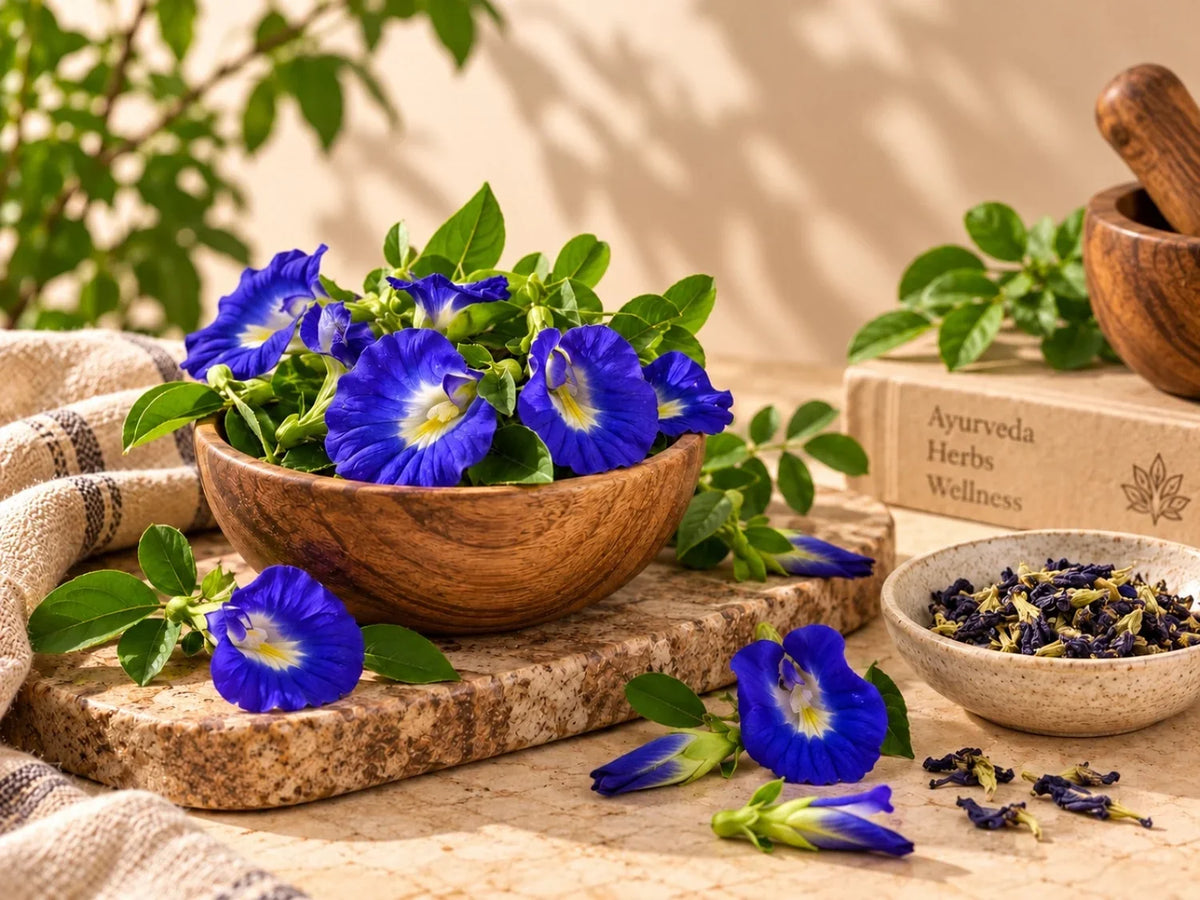
What Is Shankhpushpi?
Ask five Ayurvedic practitioners what Shankhpushpi actually is, and there is a fair chance you get five different plants. The name itself is a clue. In Hindi, Shankha means conch shell, pushpi means flower, and it describes a small, trailing herb whose blooms unfurl into the same spiral shape as a conch.
For centuries, this lesser-known herb with pale blue or white flowers has held a specific place in Ayurveda's approach to the mind. Not sedating or stimulating it, but steadying it.
Why Is Shankhpushpi Called Medhya Rasayana?
‘Medhya’ is a particular word in Ayurveda used for herbs meant to support the mind. It comes from the Sanskrit word ‘medha,’ which means intellect, and covers three abilities Ayurveda marks as important, namely, dhi, or the ability to grasp something new; dhriti, or the ability to hold on to it; and smriti, or the ability to recall it later.
Rasayana, separately, means a rejuvenative process, something taken over time to build resilience rather than fix a single symptom in one go. Put the two together, and you get Medhya Rasayana.
The Charaka Samhita, one of Ayurveda's foundational texts, names exactly four herbs under Medhya Rasayana. Those are: Mandukaparni, Yashtimadhu (liquorice), Guduchi, and Shankhpushpi.
What Shankhpushpi Has Traditionally Been Used For
Long before "focus" became a wellness buzzword, Ayurvedic physicians were using Shankhpushpi for a consistent set of concerns mentioned as follows:
-
Mental fatigue and a scattered, overactive mind
-
Difficulty settling into sleep
-
General nervous system support during periods of stress
-
As a mild digestive aid, noted for a gentle laxative effect
A distinction Ayurveda takes seriously: Shankhpushpi was rarely used to sedate someone into calm. Ancient texts describe it as clarifying the mind rather than dulling it.
From Ayurvedic Texts to Modern Laboratories
Modern researchers have taken a genuine interest in Shankhpushpi for health benefits, mostly through animal studies. Extracts of the Shankhpushpi plant have shown anxiolytic and memory-supporting effects in mice, alongside antioxidant activity linked to its flavonoid and alkaloid content. Some studies point to an effect on GABA (gamma-aminobutyric acid) activity in the brain, a primary neurotransmitter involved in calming an overstimulated nervous system.
The science is still catching up to centuries of proven observation.
Shankhpushpi Benefits for Memory, Focus & Mental Wellness
Today, Shankhpushpi shows up less often in temple gardens and more often in kitchens, probably in a cup after a long day at a screen. The reasons people reach for it are unchanged:
-
To clear mental fog after a poor night's sleep,
-
To push away the scattered feeling of too many tabs open at once,
-
Or, simply to slow down a tired brain and nervous system.
Worth remembering: Shankhpushpi is a stimulant that pushes you to focus harder. It is a herb that clears the congestion and the noise, so focus becomes easier to find on its own.
Understanding Shankhpushpi's Botanical Identity
Here is where a lot of confusion around this herb begins. So, knowing the actual botanical source matters. "Shankhpushpi" is not one single, universally agreed-upon plant. Depending on the region of India, the name has historically been applied to three or four different botanical species.
|
Region |
Plant Commonly Called ‘Shankhpushpi’ |
|
North India |
Convolvulus pluricaulis |
|
South India |
Evolvulus alsinoides or Clitoria ternatea |
|
Eastern India |
Canscora decussata |
Botanical researchers comparing these plants have found real differences in their chemical profiles. Convolvulus pluricaulis is the species most consistently linked to the Medhya Rasayana as described in ancient texts, though the naming overlap across regions still exists in the market today.
One good reminder: A natural ingredient deserves the same scrutiny as anything else you put in your body.
Shankhpushpi as Part of a Multi-Herb Formulation
There is a deeper logic behind the habit of combining herbs, one that goes back to how Ayurveda sees the mind and gut as connected rather than separate systems. Ancient Ayurveda rarely expects a single herb to do all the work, and Shankhpushpi is no exception. It appears in formulations like Saraswatarishta and various Brahmi-based tonics, typically alongside nervine herbs.
Sluggish digestion and accumulated metabolic waste were traditionally believed to shadow mental clarity no matter how many nervine herbs someone took. This is why a herb that calms the mind is so often paired with herbs that support digestion, an idea that predates the modern gut-brain conversation by a couple of thousand years.
A Note on JiViSa's Nectar of Life
Shankhpushpi sits among 13 botanical herbs present in the Nectar of Life Instant Kadha by JiViSa, alongside Ginger, Tulsi, Turmeric, Black Pepper, and Amla. And this pairing is not incidental.
Ginger's role, much like its use across Ayurveda for centuries, is to clear a sluggish throat and keep digestion active, in addition to supporting the same agni, or digestive fire, that classical texts link to mental clarity. Amla, one of Ayurveda's most respected rasayana fruits, brings antioxidant support that fits the same rejuvenative philosophy Shankhpushpi belongs to.
None of this turns a daily kadha formulated for cough, cold, and immunity into a substitute for sleep or medical care. It simply reflects our philosophy and blends ancient Ayurveda with modern science.
Haven’t tried the Nectar of Life yet? Click here to experience the goodness yourself.
PS: There is no bitterness in it!
Frequently Asked Questions
Q1. What is Shankhpushpi used for?
Traditionally, it is used to support mental clarity, calm an overactive mind, ease occasional sleeplessness, and mildly aid digestion.
Q2. Is Shankhpushpi good for memory?
Ayurveda classifies it as a medhya rasayana, a category of herbs specifically associated with the mind's ability to grasp, retain, and recall information. Some animal studies support memory-related effects, though large human trials are still limited.
Q3. Is Shankhpushpi one specific plant?
No, depending on the region, the name has historically referred to different plants, most commonly Convolvulus pluricaulis, though Evolvulus alsinoides and Clitoria ternatea are also sold under the same name in parts of India.
Q4. Can Shankhpushpi be taken daily?
In food-level amounts, such as in a formulated herbal blend, yes. Concentrated extracts or supplements are best used with guidance, particularly for anyone on medication or who is pregnant.
Q5. Why is Shankhpushpi included in herbal blends rather than taken alone?
Classical Ayurveda rarely treats the mind in isolation from digestion, which is why nervine herbs like Shankhpushpi are often combined with digestive herbs such as ginger.


